A 4CP forecast is a day-ahead and intra-day call on whether today’s hour-ending 16–19 window will hold the month’s highest ERCOT system load. Its inputs are ERCOT’s load forecast, temperature, wind generation, and day of week. Call a peak that isn’t one and you curtail for nothing; miss the real one and you pay for it all next year.
If you already know what ERCOT 4CP is — four 15-minute intervals, one per summer month, that set a larger meter’s transmission charges for the following year — the operating question is sharper: which afternoon? Nobody knows until the month closes. Everything a building does about 4CP therefore rests on a forecast, and a forecast is only useful if you understand what it watches and how it fails. This is how we think about it, from the forecasting work behind our own four buildings.
Why the peaks land in HE16–19 on hot weekdays
ERCOT system load is mostly air conditioning in summer, and air conditioning follows heat with a lag. Buildings soak up the sun through the day, so the cooling load keeps climbing after the air temperature has peaked; the hottest hour for the grid is late afternoon, not noon. Commercial load is still on at 4 and 5 p.m., and residential cooling ramps as people get home and turn thermostats down, so the two overlap in the hour-ending 16 to 19 window. Weekdays carry the full commercial load; weekends usually do not. Put those together and the month’s single highest interval is overwhelmingly likely to be a hot, humid weekday between 4 and 7 p.m. Central — which is why the 2026 peaks landed at HE17 and HE18, and why the exception (a Saturday peak in September) is worth remembering.
The signals a forecast watches
- ERCOT’s own load forecast. ERCOT publishes a day-ahead system load forecast by hour. It is the backbone of any 4CP call, and the first question each morning is whether today’s forecast peak clears the month’s running maximum at all.
- Temperature, by load center. Houston, Dallas–Fort Worth, Austin and San Antonio set the load. Forecast highs, humidity, and how many consecutive hot days have come before (heat soak) matter more than a single number.
- Wind generation. Wind barely changes demand, but it changes everything around it: a high-wind afternoon behind a cool front is rarely a peak day, and a still, hot one tightens supply enough to trigger conservation appeals and demand-response dispatch that shave the load you were trying to predict.
- Day of week and the calendar. Weekdays dominate; holidays and Fridays run lighter. A prior, not a rule — see September 2026.
- Prior-days ranking. The decisive input is the month to date. If three hotter afternoons have already passed, today has to beat all of them; a forecast that ignores the running maximum will over-call relentlessly in the back half of a month.
The 2026 peaks as a test
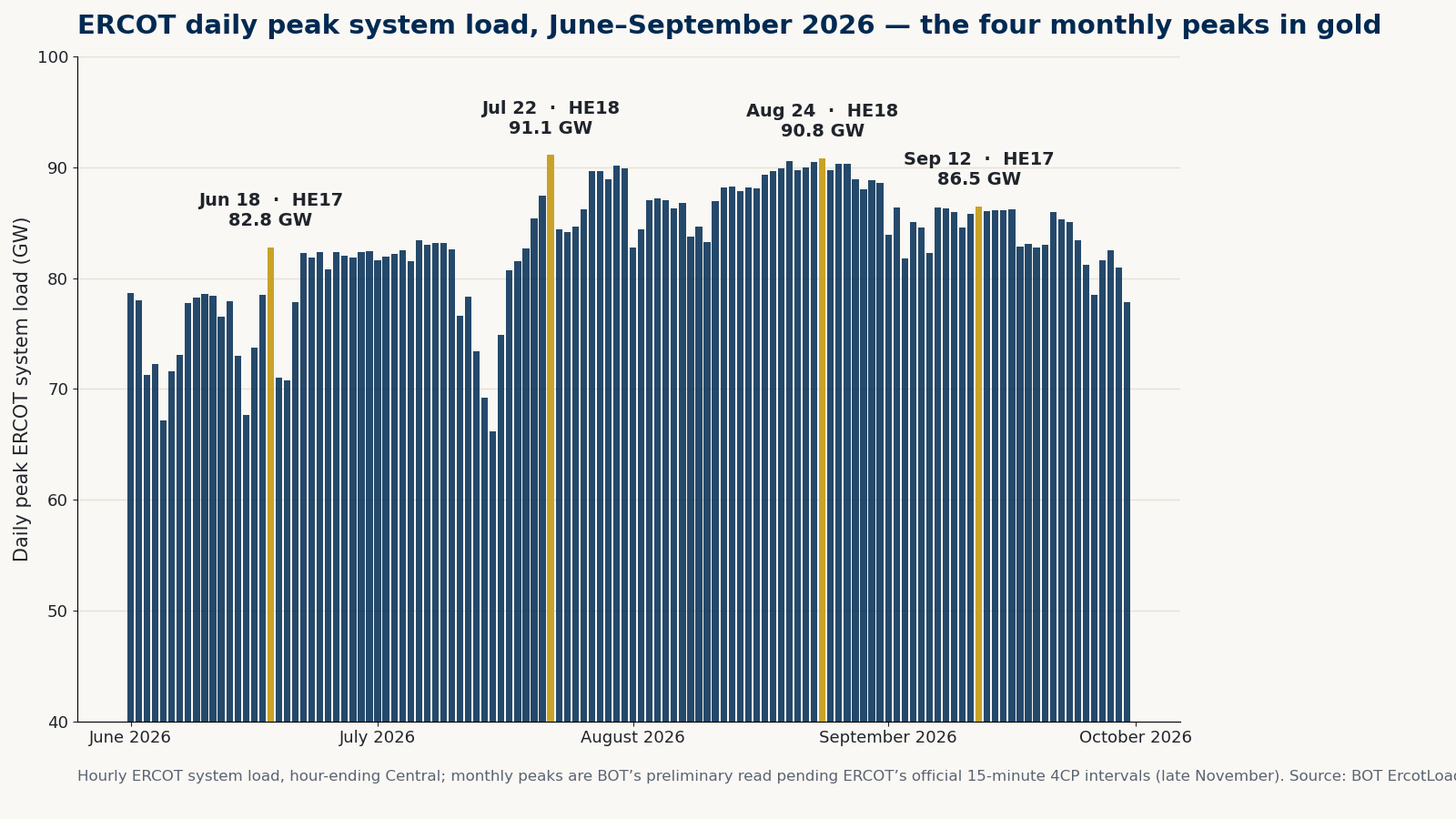
BOT’s preliminary read of ERCOT’s hourly system load puts the 2026 monthly peaks at June 18 (HE17, 82,772 MW), July 22 (HE18, 91,134 MW), August 24 (HE18, 90,817 MW), and September 12 (HE17, 86,489 MW) — the full table and what the four peaks mean for 2027 charges are in our 2026 4CP results post, which will be reconciled to ERCOT’s official 15-minute intervals when they publish in late November. Every one of the four fell in HE17 or HE18. Three fell on weekdays; the September peak landed on a Saturday, a reminder that day-of-week is a prior, not a rule. July and August set the two highest loads of the year within 350 MW of each other, four weeks apart — the kind of month where the forecaster’s running-maximum logic earns its keep, because a dozen afternoons looked like candidates and only one of them counted.
What BOT’s model does
Our forecast is an ensemble of gradient-boosted models trained on ERCOT load history and the weather that drove it: for each summer day it estimates the probability that the day holds the month’s peak and which hour that peak lands in, and it updates as the day-ahead load forecast and the weather firm up. The output is a risk level with a confidence interval, not a pretend-certain call — on a borderline afternoon the honest answer is “likely,” and the building acts on likely. Each morning that risk read goes to Ada, our optimization intelligence, which turns it into the day’s pre-cooling and coasting plan for the four buildings we operate. After every season we score the calls against ERCOT’s declared peaks and publish the result on our ERCOT 4CP page. We do not quote an accuracy percentage here, because a single number hides the two errors that matter — the peak you missed and the afternoons you curtailed for nothing — and a model should be judged on both.
Peak avoidance in an office building
A forecast only pays if the building can act on it. In an office building the playbook is mostly thermal: pre-cool the building in the late morning and early afternoon while the grid is slack, then float setpoints upward a degree or two through the risk window and let the building’s mass coast. Stage equipment so chillers, air handlers, and pumps do not all run flat out at 5 p.m., trim startup surges, and hold the strategy through the whole window rather than the forecast hour, because the interval is 15 minutes and you will not know which one. What you cannot shed is as important: life-safety systems, tenant-critical equipment, and comfort beyond what the lease allows. Done well, tenants do not notice; done badly, a 4CP afternoon becomes a complaint afternoon. The same choreography — aimed at a forecast instead of a utility’s dispatch — is what demand response asks for, and it flattens the summer demand charges on the regular bill as a side effect.
See the forecast on our own buildings
BOT forecasts 4CP risk daily, pre-cools and coasts through the window, and verifies the avoided kW at 15-minute resolution — on four West Houston buildings first, then on yours.
BOT’s ERCOT 4CP page The 2026 peaks