Demand response (DR) is the deal where electricity consumers reduce load when the grid is stressed — sometimes for direct payment, sometimes to avoid the market’s most expensive hours. On ERCOT, the grid serving most of Texas, scarcity is a summer tradition, which makes flexible commercial load genuinely valuable. The question is whether your building’s flexibility is worth monetizing, and through which door.
The doors into ERCOT demand response
- Emergency Response Service (ERS). ERCOT’s formal program paying committed loads to curtail during grid emergencies — accessed through qualified scheduling entities and aggregators, with obligations, testing, and penalties for non-performance. Real money for reliably sheddable load; a real commitment.
- Price-responsive operation. No enrollment at all: buildings on market-exposed supply arrangements simply curtail when wholesale prices spike. Requires visibility and automation more than paperwork.
- 4CP management. Texas’s signature move — for larger meters, reducing load during the four summer coincident peaks cuts next year’s transmission charges. Not formally “DR,” but the same muscles; our 4CP explainer covers it in full.
- Utility and retailer programs. Local delivery utilities and some retail providers run their own curtailment offerings, varying by territory and year.
TRY IT LIVE
Drag the cap on real building peaks
Our Demand Response apparatus uses real daily peaks from 11111 Wilcrest Green — drag the demand cap and watch what curtailment is worth in dollars.
Open the apparatusWhat a building actually curtails
Office DR is mostly an HVAC story: pre-cool ahead of the event window, then float setpoints upward a couple of degrees, shed non-critical fan and pump capacity, and dim discretionary lighting. Done through the building automation system, a well-run event trims meaningful kilowatts with occupants barely noticing. Done manually — someone jogging to mechanical rooms at 4 p.m. — it mostly generates stories.
The honest qualification test
DR pays for reliable flexibility. Before signing with any aggregator, answer three questions:
Can we shed load automatically, via the BAS, within the required response time? Can we sustain the reduction for the full event duration without a tenant revolt? Do we have the interval data to prove our baseline and performance?
Three yeses — worth pricing. Any no — fix that first; it improves your building whether or not you ever enroll.
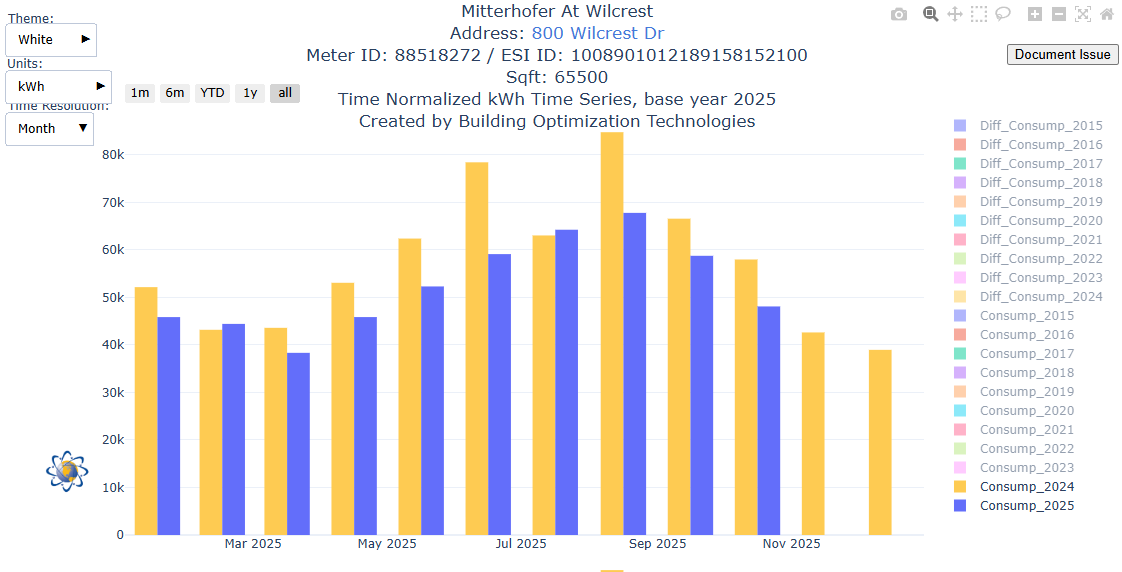
MEASURED RESULTS
The automation DR runs on, measured
After our in-house BAS beta went live around March 2025 to optimize airflow and scheduling, 800 Wilcrest posted an additional ~25% year-over-year energy reduction — the same automated-control capability demand response depends on.
See 800 Wilcrest DrDeciding if it’s worth it
Compensation scales with committed kilowatts and program stringency — and aggregator terms vary widely, so read the performance and penalty clauses as carefully as the revenue slide. For many mid-size office buildings the sober ranking is: 4CP management first (largest, most predictable Texas payoff), price-awareness second, formal ERS third — pursued once automated shed capability is proven. All three run on the same foundation: interval metering, integrated controls, and someone watching the data — which is precisely how Building Optimization Technologies runs our own four buildings, ERCOT peak season tracked and published.
See peak-season discipline in practice
We publish ERCOT 4CP season reports for our own portfolio — the operating transparency we’d want from any building we leased in.
Explore the portfolio Read the 4CP explainerProgram rules, eligibility, and compensation change season to season — verify current ERCOT and utility program terms before making commitments.