Houston’s office market always has sublease space — companies downsize, consolidate, or relocate, and their leftover space hits the market at a discount. For the right tenant, subleases are genuinely cheap. But the discount exists for a reason, and the reason is risk you inherit.
What a sublease actually is
You’re not leasing from the building owner — you’re leasing from another tenant (the “sublandlord”) who remains on the hook for the original lease. Your rights ride on top of theirs: their lease terms bind you, their landlord must usually consent to your deal, and if they default or their lease ends, your position can end with it.
The five things to check before signing
- The master lease. Read it — your sublease can’t give you rights the sublandlord doesn’t have. Watch for restrictions on use, signage, and alterations.
- Term runway. Your sublease ends when the master lease does (or earlier). A great rate on 14 remaining months may just relocate your problem to next year.
- Sublandlord health. If they stop paying their rent, the landlord’s remedies can reach your space regardless of your perfect payment record.
- As-is condition. Sublease space usually comes exactly as the last team left it — layout, wear, and all. Budget for what you can’t change.
- Consent and timing. Landlord consent can take weeks and isn’t guaranteed. If your move-in date is firm, that delay is a real cost.
The alternative nobody prices: a short, flexible direct lease
The main reason tenants chase subleases is flexibility — shorter commitments than the standard five-to-seven-year direct deal. But owner-operated buildings can simply… offer shorter terms. Because we own our four buildings and make our own decisions, we can structure lease lengths to the tenant instead of to an institutional playbook — without the second-hand risk stack of a sublease.
You get a clean, direct relationship with the building owner, space in the condition you agreed to, and a term that fits your planning horizon. The rate may be a notch above the distressed sublease down the street — the difference is you’re not underwriting a stranger’s balance sheet.
| Building | Submarket | Asking rate |
|---|---|---|
| 800 Wilcrest Dr | Westchase · 77042 | $15 /SF/yr |
| 11111 Wilcrest Green Dr | Westchase · 77042 | $15 /SF/yr |
| 11200 Richmond Ave | West Houston · 77082 | $18–$20 /SF/yr |
| 11104 West Airport Blvd | Stafford · 77477 | $21 /SF/yr |
Gross Modified asking rates as of mid-2026; individual suites vary by size, term, and condition.
Ask us about flexible terms, direct
Tell us your timeline — as the owner-operator we can talk term length, not just rate. Every suite has published pricing and a 3D walkthrough.
Browse available suites How our pricing works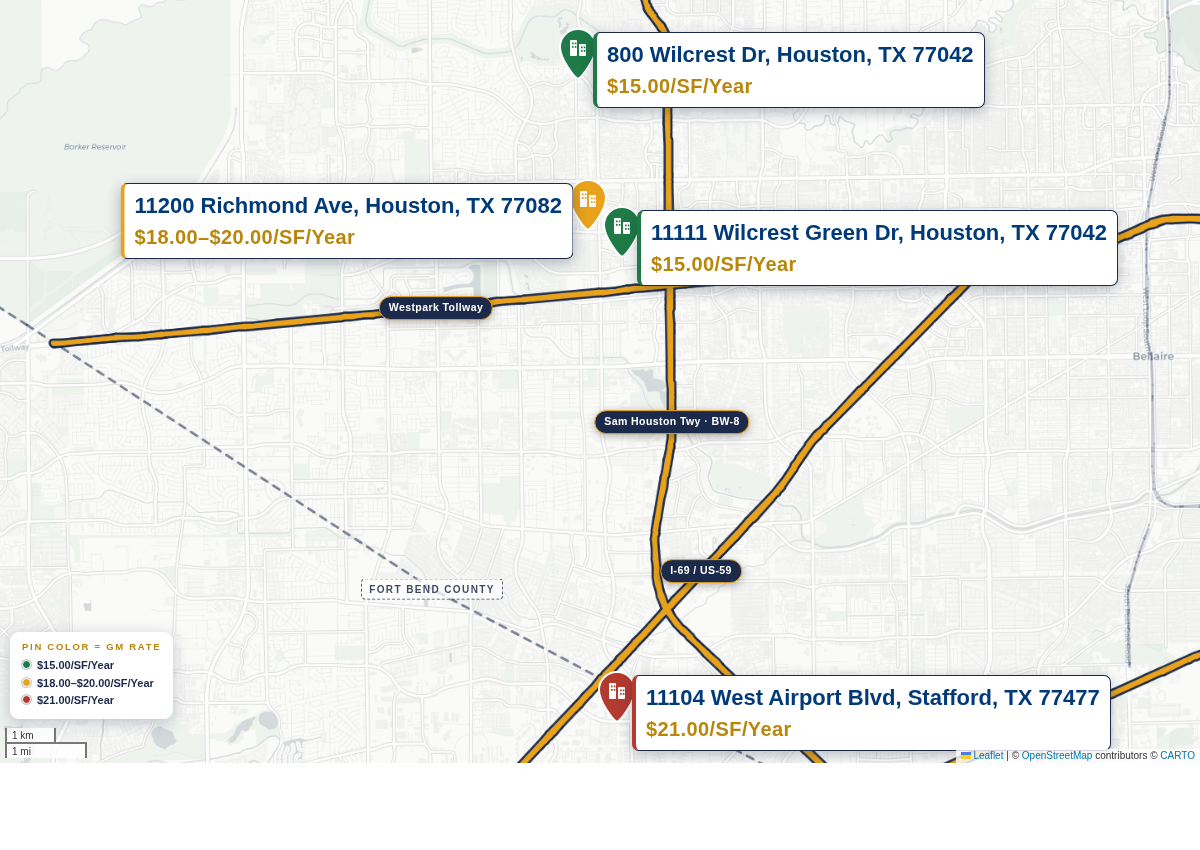
FROM OUR PORTFOLIO
Where the direct-lease alternative sits
All four G&W buildings across West Houston and Stafford, with current Gross Modified rates and available square-footage ranges shown on each pin.
Open the interactive mapTRY IT LIVE
90-second narrated portfolio tour
A quick narrated tour of the portfolio, available in English or Spanish — see the buildings before you pick up the phone.
Watch the tourBottom line
Take the sublease when the discount is deep, the remaining term genuinely fits your horizon, the sublandlord is solid, and the space works as-is. When any of those wobble — or when you just want the landlord’s phone number to reach the actual decision-maker — a flexible direct lease from an owner-operator is the cleaner instrument. (Sublease structures vary; have an attorney review any sublease and master lease before signing.)