
If you're pricing office space in Houston, you've probably noticed the numbers are hard to compare. One listing quotes $18 a foot, another quotes $30, and they're describing spaces that feel similar. The gap almost always comes down to three things: where the building is, what class it is, and how the lease is structured. Get those three straight and the market suddenly makes sense.
This guide breaks down each one and grounds it in real, current pricing from a portfolio of four Class A office buildings across West Houston — so you're working from actual numbers, not asking-rate averages that hide as much as they reveal.
The three things that set your Houston office cost
1. Rate per square foot (PSF). The headline number, quoted annually. A 1,500 SF suite at $18/SF/yr is $27,000 a year, or $2,250 a month, before anything else.
2. Lease structure. This is the one people underestimate. A "$15 gross modified" rate and a "$15 triple net" rate are not the same deal — the NNN tenant pays operating costs on top. Always ask what structure a quote is on before you compare it to anything. (More on this below.)
3. Everything else. After-hours HVAC, in-suite electricity, janitorial, parking, buildout, and the security deposit. Individually small; together they move your effective rate by several dollars a foot.
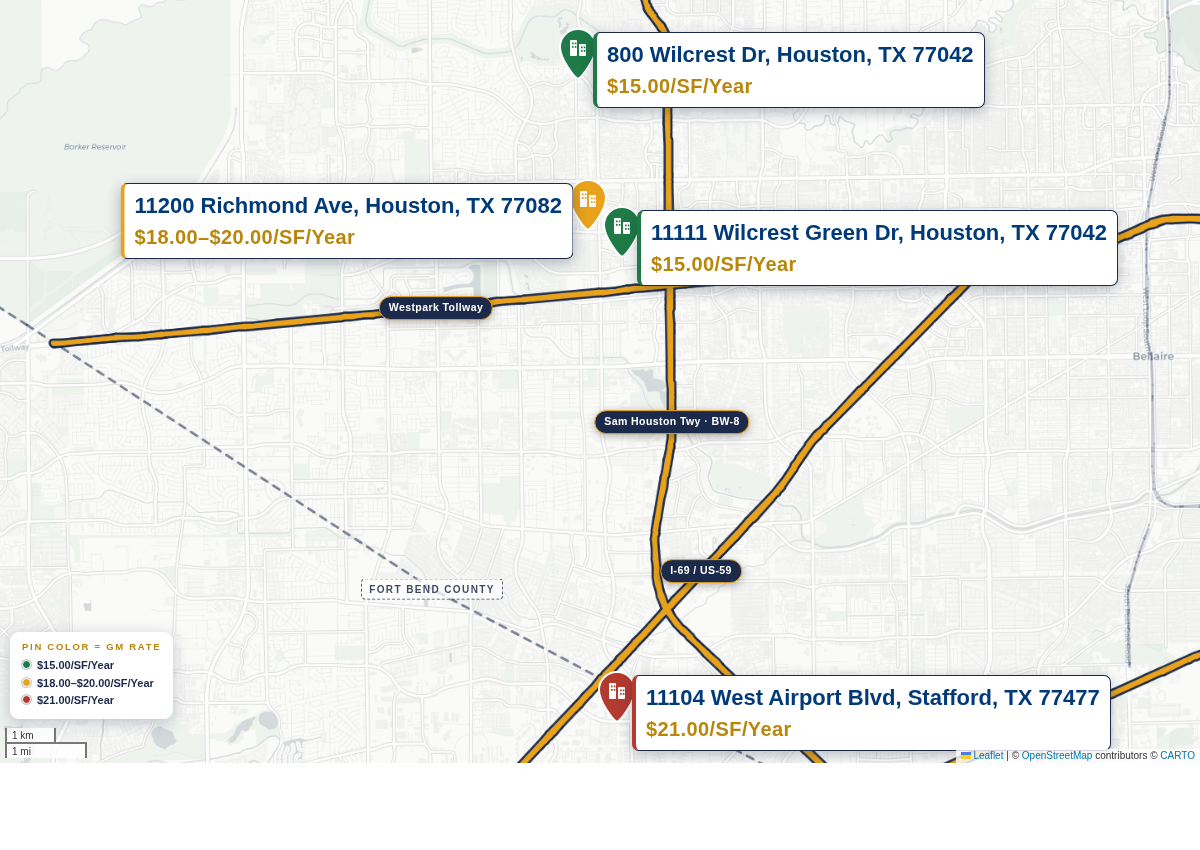
Houston office building rent by class (2026)
All four of our buildings are Class A. Here are current asking rates across four owner-operated buildings in Westchase, West Houston, and Stafford. All are quoted Gross Modified, so most operating costs are already inside the number — which makes them more directly comparable to each other than mixed quotes elsewhere.
| Building | Submarket | Year | Asking rate |
|---|---|---|---|
| 800 Wilcrest Dr | Westchase · 77042 | 1983 | $15 /SF/yr |
| 11111 Wilcrest Green Dr | Westchase · 77042 | — | $15 /SF/yr |
| 11200 Richmond Ave | West Houston · 77082 | 1999 | $18–$20 /SF/yr |
| 11104 West Airport Blvd | Stafford · 77477 | 1983 | $21 /SF/yr |
Individual suites currently range from roughly 470 SF to 25,884 SF across the four buildings. Rates are asking rates and can vary by suite, term, and condition.
A few things worth reading out of that table. The two Westchase buildings anchor the low end at $15 — attractive for a Class A address inside a major business district. The newest building, 11200 Richmond (built 1999), commands a premium for its age and finishes. And the Stafford building tops the range at $21, which reflects its location advantages south of the Westchase core.
TRY IT LIVE
Compare all four buildings on one map
The interactive locations map plots all four G&W buildings with live rates, so you can weigh submarket against price in one view.
Open the interactive mapWhat "Gross Modified" actually means for your budget
This is the single most useful lease concept to understand, because it determines whether that PSF number is close to your real cost or just the starting line.
Gross Modified vs. Full-Service vs. Triple Net
Gross Modified (Modified Gross) — base rent bundles most operating costs (property taxes, insurance, common-area maintenance, building services). The tenant typically pays a few items directly, commonly in-suite electricity and janitorial, and/or their share of operating-cost increases above a base year.
Full-Service Gross (FSG) — the landlord covers nearly everything, including in-suite utilities and janitorial. Simplest to budget; usually a higher headline rate to compensate.
Triple Net (NNN) — the tenant pays base rent plus their pro-rata share of taxes, insurance, and CAM on top. A low NNN base rate can end up costing more than a higher gross rate once those pass-throughs are added.
The practical takeaway: when a Gross Modified building quotes you $18/SF, you're much closer to your all-in occupancy cost than an $18 NNN quote, where taxes, insurance, and CAM still stack on. Always normalize quotes to the same structure before deciding one is "cheaper." Confirm the exact inclusions for any specific suite before you sign — the details vary lease to lease. (This is general information, not legal or financial advice.)
The costs tenants forget to budget
Even under a gross structure, a handful of items land outside base rent. None is huge on its own; together they're the difference between a budget that holds and one that slips:
After-hours HVAC. Buildings run air conditioning on a standard schedule; extended hours are usually billed hourly. If your team works nights or weekends, ask the rate up front.
In-suite electricity & janitorial. Under Gross Modified these are often the tenant's — modest, but real, and worth confirming.
Parking. In West Houston surface parking is typically included, which is a genuine cost advantage over downtown or the Galleria, where structured parking is often charged per space.
Buildout / tenant improvements. If a suite needs reconfiguring, that's negotiated separately — sometimes as a landlord allowance, sometimes amortized into rent.
Security deposit. Commonly one to two months' rent, due at signing. Budget it as upfront cash, not an operating cost.
How to lower your effective cost
Right-size the suite. The fastest savings is not paying for square footage you won't use. This is exactly where interactive 3D suite tours earn their keep — you can walk a space and judge whether 900 SF genuinely works before you commit to 1,400.
Negotiate on the right structure. On a Gross Modified lease, the levers are the base rate, the base year for expense increases, free rent, and TI allowance. Know which one matters most for your situation before you sit down.
Choose a building that actively manages its energy. Operating costs don't stay flat on their own. These four buildings are run on the principle of "efficiency through data" — continuously monitored and tuned by Building Optimization Technologies — which keeps the operating side of your rent under control rather than drifting up year over year.
Lease direct from the owner. These buildings are owner-operated, so you deal with the decision-maker — typically faster answers and no third-party markup layered onto the space.
See real suites and current prices
Browse live availability across all four West Houston buildings — every suite has a furnished 3D walkthrough and a downloadable spec sheet.
Browse available suites View 11200 Richmond