If your question is “what is an EMIS,” start with the EMIS explainer — it covers what the category does and how it differs from a building automation system. This piece assumes you already know, and are now facing five vendors whose demos are indistinguishable. Here is how to tell them apart.
The eight criteria that actually matter
- 1. Data in. Can it ingest what you actually have — interval utility data, submeters, BAS points over BACnet or Modbus, weather — without a six-month integration project? Ask what the integration costs and who does it. That answer is frequently larger than the licence.
- 2. Data out. Can you export everything, on demand, in a usable format? Is there an API? If the answer is a shrug, you are not buying software; you are renting access to your own building’s history.
- 3. Analytics that name an action. An anomaly flag is not an insight. “AHU-3 is running Saturdays” is. The test is whether the output tells a technician what to do, or merely that something is odd.
- 4. Alerting a human will actually act on. Signal-to-noise decides everything. A system that fires forty alerts a week trains its operator to ignore all forty. Ask how alerts are tuned, suppressed, and closed — not how many rules ship.
- 5. Real baselining. Can it build a defensible baseline and adjust for weather and occupancy — the machinery of measurement and verification? If it cannot, every savings figure it produces is a difference, not a saving.
- 6. Reporting for the audience you have. Owner, tenant, lender, and ESG reporting are four different documents. Find out which ones come out of the box and which are a professional-services engagement.
- 7. Total cost, in year two. Licensing per meter or per point, integration labor, and the service line. Year one is priced to win. Model year two and year three.
- 8. Who tunes it after the honeymoon. The single strongest predictor of whether a deployment survives. If nobody’s job description includes this platform in eighteen months, do not buy it.
The uncomfortable truth about the category
Software does not save energy. Decisions save energy. Software makes better decisions possible, faster, and easier to defend — and that is genuinely worth paying for.
But a platform bought instead of a habit is a very expensive screensaver. Buy the habit first; then buy the tool that makes it cheaper.
Run a ninety-day pilot on one building
Do not buy a portfolio licence off a demo. Pick your most instrumented building, define three questions you want answered — where is the off-hours load, which unit is drifting, what set last month’s peak — and see whether the platform answers them without a consultant. Then check the only metric that matters: did anyone log in during week ten, unprompted?
How to compare energy management software companies
The eight criteria above judge the product. A separate question decides the outcome: who is behind it? A company can ship a capable dashboard and still fail you on the parts that never surface in a demo. Score each vendor on four company-level traits. Support model: is there a named human who reviews your data and flags what matters, or a ticket queue and a help center? Data ownership and export: is the interval data yours, in an open format you can pull at will, or hostage inside their platform? Exit path: if you leave in year three, what do you keep and what breaks? Integration track record: have they actually connected to the meters, building automation system, and utility feeds you run — not the reference architecture on the slide, the messy real one? A capable product from a company that fails these becomes an expensive orphaned login the day your champion changes jobs.
Red flags
- A savings percentage quoted before anyone has seen your data.
- Export described as “available on request.”
- Integration priced as “typical” without a point list.
- A demo built on someone else’s beautiful building.
- Analytics that cannot explain why they flagged something.
- A vendor who will also be verifying their own savings.
Where the software sits in the stack
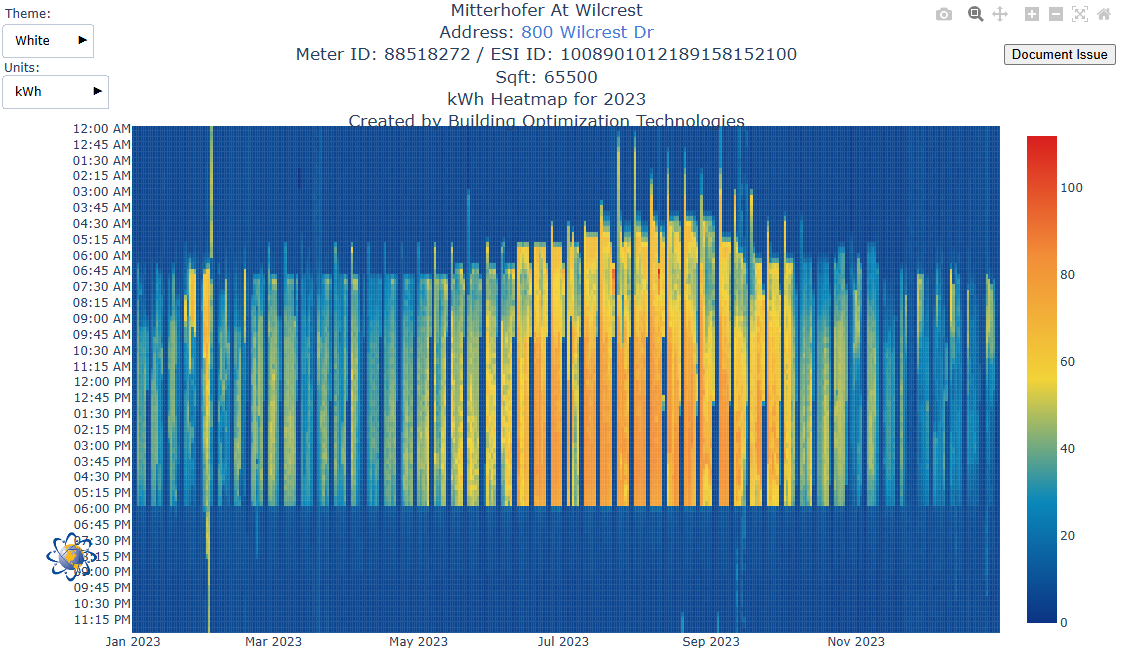
Underneath it you need control — a building automation system that can act on what the software finds; the BAS cost guide covers what that layer really involves. Above it you need someone who looks. In between, the software earns its keep by turning interval data into a short list of things worth doing this week. That is the whole job. When it works, it looks like the results at 800 Wilcrest: unglamorous operational fixes, found early, repeated forever.
We are operators, not resellers
BOT runs this stack across four Class A buildings in West Houston — and publishes the results, including the caveats.
Explore the portfolio What an EMIS actually does